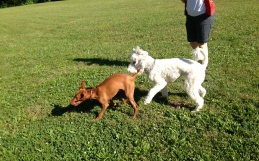
New Research on Dog Emotions and Jealousy
A few weeks ago, I had an interesting conversation with a dog trainer from IL, Chad Makin. He brought to my attention that there have been recent tests that show that dog’s DO in fact have more complex emotions that what was previously thought. I had been taught that dogs have simple feelings and emotions. They can feel sadness, loss, fear, and happiness, but for a dog to be feel jealousy or to be able to reason was obscure. Newer tests have been brought to my attention and the results are mind blowing. As a canine professional, it is easy to think that you may know it all. I beg to differ. If you are a canine professional or professional in any industry and you think you know all there is to know about your target industry, you, my friend, need to find a new job. One of the reasons I choose to be a dog trainer was the fact that I am always learning new things. Just a surgeon has to stay up to date on current tests, studies, and scientific findings, dog trainers, and canine professionals in general, have to be open to changes and contradictions to their beliefs. They have to be willing to adapt and or change to current knowledge canine behavior, thought processes, health, and overall well-beings of dogs. I personally try to be as minded as anyone can be to provide the most accurate and best care for my clients and their four-legged friend.
Why Dog Trainers Must Never Stop Learning
Krystal Nierman
Owner, Head Trainer
Dog Psychology and Training Center
Frequently Asked Questions About Dogs and Jealousy
Can dogs really feel jealousy, or is it just instinct?
As this article explains, recent tests suggest that dogs have more complex emotions than was previously thought. While dogs were long believed to experience only simple feelings such as sadness, loss, fear, and happiness, newer findings point toward jealousy as a genuine canine emotion rather than simple instinct alone.
Why do dog trainers need to keep learning about canine emotions?
In the article, Krystal Nierman notes that canine professionals must stay open to changes and contradictions to their beliefs, just as a surgeon stays up to date on current tests and scientific findings. Being willing to adapt to current knowledge of canine behavior, thought processes, and health is part of providing the most accurate and best care for clients and their four-legged friends.
What should I do if my dog seems jealous?
Because research on canine jealousy is still developing, the article's takeaway is to stay open-minded and keep learning about dog behavior and psychology. If jealousy-related behavior is causing problems at home, working with a professional who follows current canine behavior research is the best next step.
Does this change how Fort Wayne dog training is approached?
The article makes the case that dog trainers and canine professionals should be willing to adapt and change to current knowledge of canine behavior. That means training approaches can evolve as new studies and scientific findings about dog emotions come to light.
Where can I learn more about dog behavior and psychology?
You can explore the related posts on this page, browse the Training Tips and Videos sections, or get in touch with the Dog Psychology and Training Center to ask questions about your own dog's behavior.